
The greatest Western actors include John Wayne, Gary Cooper, James Stewart, Henry Fonda and Clint Eastwood, joined by a second wave from Italy (Lee Van Cleef, Franco Nero and Terence Hill), followed by Kevin Costner, Jeff Bridges and Tommy Lee Jones. A Western actor is a performer whose career is closely tied to the American West: the horse, the Colt, the hat and that silence that says more than dialogue ever could.
Below, you’ll find 25 legends grouped by era, with a classic film for each, its release year and director, followed by 10 films to watch and, finally, some tips on borrowing their look without looking like you’re in costume.
Hollywood’s golden age: the actors who founded the genre
Between the late 1930s and the early 1960s, Hollywood churned out Westerns. This was when the conventions took shape: the honest sheriff, the weary gunslinger, the dusty town and the showdown outside the saloon. American Western actors from this era all had one thing in common: a physical presence that was enough to fill the screen.
John Wayne, the face of the Western
Born in 1907 and passing away in 1979, John Wayne became a star with John Ford’s Stagecoach (1939). The Ford–Wayne partnership went on to produce The Searchers (1956) and The Man Who Shot Liberty Valance (1962), while Howard Hawks directed him in Red River (1948) and Rio Bravo (1959).
He won his only Academy Award for Best Actor for Henry Hathaway’s True Grit (1969), playing the one-eyed marshal Rooster Cogburn. For many, he remains the most famous Western actor of all.
Gary Cooper and James Stewart, men of principle
Gary Cooper (1901–1961) made a name for himself as early as 1929 with The Virginian, his first talkie. His strongest role was Marshal Will Kane in Fred Zinnemann’s High Noon (1952), which earned him his second Academy Award for Best Actor after Sergeant York. He also starred alongside Burt Lancaster in Vera Cruz (1954).
James Stewart (1908–1997) began as the affable American in comedies. With Anthony Mann, he made five darker Westerns between 1950 and 1955, including Winchester ’73 (1950), The Naked Spur (1953) and The Man from Laramie (1955). His character became tougher, sometimes obsessed with revenge, and that change is what made him one of the greats of the genre.
Henry Fonda, Randolph Scott and Alan Ladd
Henry Fonda (1905–1982) played Wyatt Earp in John Ford’s My Darling Clementine (1946), then a rigid officer in Fort Apache (1948). Twenty years later, he surprised everyone by playing Frank, the child-killing villain in Once Upon a Time in the West.
Randolph Scott (1898–1987) devoted almost his entire career to Westerns. His seven films with Budd Boetticher, including Comanche Station (1960), are now highly regarded, and he bade farewell to the genre with Sam Peckinpah’s Ride the High Country (1962), alongside Joel McCrea. Alan Ladd (1913–1964), meanwhile, will always be the mysterious rider in George Stevens’ Shane (1953).
Burt Lancaster and Kirk Douglas, the OK Corral duo
In 1957, John Sturges cast Burt Lancaster (1913–1994) as Wyatt Earp and Kirk Douglas (1916–2020) as Doc Holliday in Gunfight at the O.K. Corral. Lancaster had already made Vera Cruz and Apache with Robert Aldrich in 1954, and returned to the genre with The Professionals (1966).
Kirk Douglas, who died aged 103, considered Lonely Are the Brave (1962) his favourite film: the story of a cowboy who refuses to accept the modern world and its fences.
The 1960s and ’70s: Clint Eastwood, Sergio Leone and the spaghetti Western
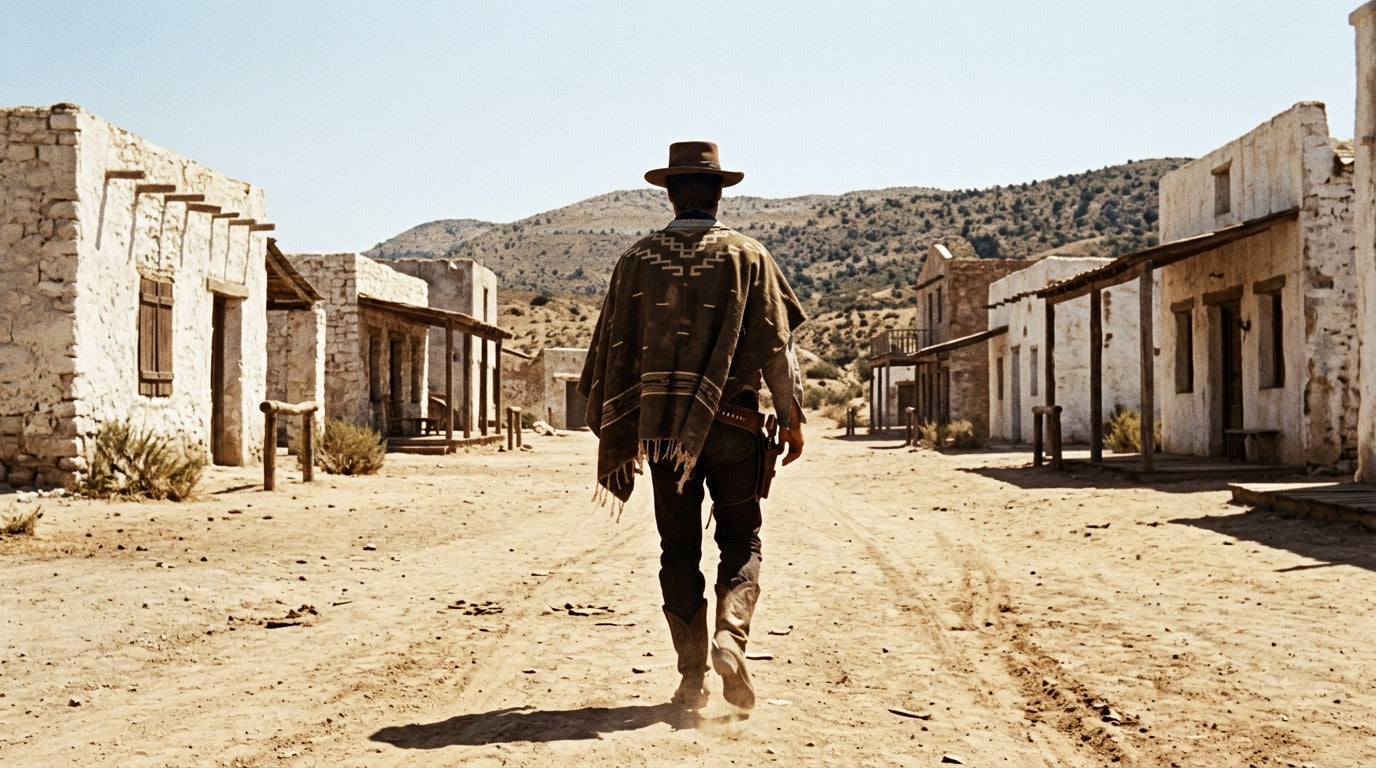
By the early 1960s, the American Western was running out of steam. Italian filmmakers revived it, often shooting in Spain, with less straightforward heroes and more confronting violence. It was called the spaghetti Western, at first ironically, and later with respect.
Clint Eastwood and the Dollars Trilogy
Clint Eastwood, born on 31 May 1930 in San Francisco, made a name for himself on television in the series Rawhide (1959–1965), where he played Rowdy Yates. Sergio Leone then cast him in A Fistful of Dollars (1964), For a Few Dollars More (1965) and The Good, the Bad and the Ugly (1966). The poncho, cigarillo and narrowed gaze became his signature.
Back in the United States, he moved behind the camera and made The Outlaw Josey Wales (1976). He was the quintessential Western actor of the ’70s, bridging Ford’s classic style and the disillusioned Western.
Lee Van Cleef, Eli Wallach and Charles Bronson
Lee Van Cleef (1925–1989) made his debut without a line of dialogue, as a silent gunman in High Noon. Leone cast him as Colonel Mortimer in For a Few Dollars More, then as Angel Eyes, “the Bad”, in the next film. Eli Wallach (1915–2014), the bandit Calvera in The Magnificent Seven (1960), became Tuco, “the Ugly” — a role that made his name. He received an honorary Oscar in 2010.
Charles Bronson (1921–2003) was one of John Sturges’ Magnificent Seven before becoming the harmonica-playing man in Once Upon a Time in the West (1968). Leone’s film, driven by Ennio Morricone’s music, also featured Henry Fonda, Jason Robards and Claudia Cardinale.
Franco Nero, Giuliano Gemma, Terence Hill and Bud Spencer
Italian Westerns weren’t limited to Leone. Franco Nero, born in 1941, drags a coffin through the mud in Sergio Corbucci’s Django (1966); Tarantino gave him a nod in Django Unchained in 2012. Giuliano Gemma (1938–2013), sometimes credited as Montgomery Wood, scored a hit with Duccio Tessari’s A Pistol for Ringo (1965), then appeared alongside Lee Van Cleef in Tonino Valerii’s Day of Anger (1967).
With Terence Hill (real name Mario Girotti, born in 1939) and Bud Spencer (Carlo Pedersoli, 1929–2016), the genre shifted towards comedy. Enzo Barboni’s They Call Me Trinity (1970) and its 1971 sequel swapped shoot-outs for fistfights. A little-known fact: Bud Spencer competed in swimming at the Olympic Games in Helsinki in 1952 and Melbourne in 1956.
American Westerns of the same era
Meanwhile, Hollywood was changing too. Steve McQueen (1930–1980) went from the TV series Wanted: Dead or Alive (1958–1961) to The Magnificent Seven, a remake of Kurosawa’s Seven Samurai. Paul Newman (1925–2008) and Robert Redford teamed up in George Roy Hill’s Butch Cassidy and the Sundance Kid (1969), while Sam Peckinpah captured the end of an era in The Wild Bunch (1969).
Western actresses: far more than sidekicks
Westerns are often reduced to a man’s world. That overlooks the actresses who took leading roles, sometimes tougher than those of their co-stars.
- Barbara Stanwyck (1907–1990) leads an army of riders in Samuel Fuller’s Forty Guns (1957), then rules a Californian ranch as Victoria Barkley in the series The Big Valley (1965–1969). In 1954, she co-starred in Cattle Queen of Montana with a certain Ronald Reagan.
- Maureen O’Hara (1920–2015) was John Wayne’s favourite co-star: John Ford’s Rio Grande (1950), McLintock! (1963) and Big Jake (1971).
- Grace Kelly (1929–1982) played Gary Cooper’s young Quaker wife in High Noon, four years before becoming Princess of Monaco.
- Claudia Cardinale (1938–2025) played Jill McBain, the former prostitute who becomes a widow and landowner in Once Upon a Time in the West. She died on 23 September 2025 in Nemours, aged 87.
- Jane Fonda, Henry Fonda’s daughter, played the title role in Elliot Silverstein’s Cat Ballou (1965), a Western comedy that won Lee Marvin the Academy Award for Best Actor for his dual role.
If you’re looking for the feminine equivalent of these iconic looks, our article on celebrities and the Western, from Yellowstone to TikTok shows how today’s stars are bringing these codes back.
The modern Western: from Kevin Costner to Yellowstone
After a long dry spell in the 1980s, the genre returned to the spotlight with two films that swept the Oscars. Since then, every decade has had its own major Western, and the series Yellowstone has brought ranch life into millions of living rooms.
Kevin Costner and Clint Eastwood revive the genre
Kevin Costner, born in 1955, directed and starred in Dances with Wolves (1990), which won seven Academy Awards, including Best Picture and Best Director. He followed it with Lawrence Kasdan’s Wyatt Earp (1994), then directed Open Range (2003) and Horizon: An American Saga (2024).
Two years after Costner, Clint Eastwood made Unforgiven (1992), a Western that dismantles the myth of the lone avenger. The film won four Academy Awards: Best Picture, Best Director, Best Film Editing and Best Supporting Actor for Gene Hackman, who died in 2025. Eastwood retired from filmmaking in 2026, aged 96.
Tommy Lee Jones, Sam Elliott and Jeff Bridges
Tommy Lee Jones, born in 1946, played Captain Woodrow Call in the miniseries Lonesome Dove (1989). He directed and starred in The Three Burials of Melquiades Estrada (2005), which won the Best Actor award at Cannes, followed by The Homesman (2014).
Sam Elliott, born in 1944, with his moustache and deep voice, played Virgil Earp in Tombstone (1993) and Shea Brennan in 1883 (2021–2022), a role that earned him a Screen Actors Guild Award. Jeff Bridges, born in 1949, took on the role of Rooster Cogburn in Joel and Ethan Coen’s True Grit (2010); the film received ten Academy Award nominations, including one for Bridges as Best Actor.
Tarantino, Brad Pitt and the new generation
In Django Unchained (2012), Quentin Tarantino cast Jamie Foxx as the freed slave Django, Leonardo DiCaprio as plantation owner Calvin Candie and Christoph Waltz as the German bounty hunter. Waltz won his second Academy Award for Best Supporting Actor for the role. DiCaprio later won the Academy Award for Best Actor for The Revenant, a film about fur trappers rather than a Western in the strictest sense.
Brad Pitt played Jesse James in Andrew Dominik’s The Assassination of Jesse James by the Coward Robert Ford (2007), winning the Volpi Cup for Best Actor in Venice.
Yellowstone: the Western as a TV series
Broadcast from June 2018 to December 2024, Yellowstone, created by Taylor Sheridan and John Linson, ran for five seasons. Kevin Costner plays John Dutton, owner of a vast Montana ranch, a role that earned him the Golden Globe for Best Actor in a Television Series – Drama in 2023. The series spawned 1883 and brought felt hats and snap-button shirts back into fashion well beyond the United States.
25 Western actors and 10 films: the essentials at a glance
The 25 legends in a table
| Actor | Years | Classic film (year, director) | What to know |
|---|---|---|---|
| John Wayne | 1907–1979 | The Searchers (1956, John Ford) | Academy Award for Best Actor for True Grit (1969) |
| Gary Cooper | 1901–1961 | High Noon (1952, Fred Zinnemann) | Won his second Academy Award for Best Actor for this role |
| James Stewart | 1908–1997 | Winchester ’73 (1950, Anthony Mann) | Five Westerns with Anthony Mann |
| Henry Fonda | 1905–1982 | My Darling Clementine (1946, John Ford) | Wyatt Earp for Ford, villain for Leone |
| Randolph Scott | 1898–1987 | Ride the High Country (1962, Sam Peckinpah) | Seven Westerns with Budd Boetticher |
| Alan Ladd | 1913–1964 | Shane (1953, George Stevens) | The classic lone rider |
| Burt Lancaster | 1913–1994 | Vera Cruz (1954, Robert Aldrich) | Wyatt Earp in Gunfight at the O.K. Corral (1957) |
| Kirk Douglas | 1916–2020 | Gunfight at the O.K. Corral (1957, John Sturges) | Doc Holliday; died aged 103 |
| Paul Newman | 1925–2008 | Butch Cassidy and the Sundance Kid (1969, George Roy Hill) | Iconic duo with Robert Redford |
| Steve McQueen | 1930–1980 | The Magnificent Seven (1960, John Sturges) | Made his name in the series Wanted: Dead or Alive |
| Clint Eastwood | born 1930 | The Good, the Bad and the Ugly (1966, Sergio Leone) | Best Picture and Best Director Oscars for Unforgiven |
| Lee Van Cleef | 1925–1989 | For a Few Dollars More (1965, Sergio Leone) | First silent role in High Noon |
| Eli Wallach | 1915–2014 | The Good, the Bad and the Ugly (1966, Sergio Leone) | Tuco; honorary Oscar in 2010 |
| Charles Bronson | 1921–2003 | Once Upon a Time in the West (1968, Sergio Leone) | The man with the harmonica |
| Franco Nero | born 1941 | Django (1966, Sergio Corbucci) | Cameo in Django Unchained (2012) |
| Terence Hill | born 1939 | They Call Me Trinity (1970, Enzo Barboni) | Real name Mario Girotti |
| Bud Spencer | 1929–2016 | They Call Me Trinity (1970, Enzo Barboni) | Olympic swimmer in 1952 and 1956 |
| Giuliano Gemma | 1938–2013 | A Pistol for Ringo (1965, Duccio Tessari) | Sometimes credited as “Montgomery Wood” |
| Barbara Stanwyck | 1907–1990 | Forty Guns (1957, Samuel Fuller) | Series The Big Valley (1965–1969) |
| Maureen O’Hara | 1920–2015 | Rio Grande (1950, John Ford) | Regular co-star of John Wayne |
| Claudia Cardinale | 1938–2025 | Once Upon a Time in the West (1968, Sergio Leone) | Jill McBain, the heart of the film |
| Kevin Costner | born 1955 | Dances with Wolves (1990, Kevin Costner) | Seven Academy Awards; John Dutton in Yellowstone |
| Jeff Bridges | born 1949 | True Grit (2010, Joel and Ethan Coen) | Rooster Cogburn, 40 years after John Wayne |
| Tommy Lee Jones | born 1946 | The Three Burials of Melquiades Estrada (2005, Tommy Lee Jones) | Best Actor award at Cannes |
| Sam Elliott | born 1944 | Tombstone (1993, George P. Cosmatos) | Shea Brennan in 1883 |
10 Western films to watch at least once
If you want to discover the genre without getting lost, here’s a short list in chronological order. It covers three eras of the cowboy film: the Hollywood classic, the Italian Western and the twilight Western.
- Stagecoach (1939, John Ford): the stagecoach, John Wayne and the Western coming of age.
- Red River (1948, Howard Hawks): a cattle drive and a generational conflict between John Wayne and Montgomery Clift.
- High Noon (1952, Fred Zinnemann): a sheriff standing alone against everyone, almost in real time.
- Shane (1953, George Stevens): the rider who protects a farming family.
- The Searchers (1956, John Ford): often named the greatest Western ever made.
- Rio Bravo (1959, Howard Hawks): friendship, a jail and a handful of men holding their ground.
- The Magnificent Seven (1960, John Sturges): Yul Brynner, Steve McQueen and Charles Bronson come to a village’s rescue.
- The Good, the Bad and the Ugly (1966, Sergio Leone): the high point of the Dollars Trilogy.
- Once Upon a Time in the West (1968, Sergio Leone): the arrival of the railway and the end of an era.
- Unforgiven (1992, Clint Eastwood): a Western reckoning with its own legend.
If you want more, add The Wild Bunch (1969), Dances with Wolves (1990) and Django Unchained (2012).
Blue eyes, the White House and real cowboys: three special portraits
Western actors with blue eyes
When people search for “Western actor blue eyes”, three names often come up. Paul Newman may have had Hollywood’s most famous blue eyes; in Hud (1963), a contemporary Western set in Texas, his gaze turns icy. Terence Hill, nicknamed “ice eyes” in Italy, made his blue eyes and smile Trinita’s main weapons.
Henry Fonda is the most interesting case. Sergio Leone loved the contrast between his innocent-looking blue eyes and the cruelty of killer Frank: audiences in the 1960s didn’t expect to see the actor who played Wyatt Earp shoot a child.
Ronald Reagan, the Western actor who became president
The American president who acted in Westerns was Ronald Reagan (1911–2004), the 40th president of the United States from 1981 to 1989. Before politics, he made several Westerns: he played George Custer in Michael Curtiz’s Santa Fe Trail (1940), alongside Errol Flynn, then appeared in The Last Outpost (1951), Law and Order (1953), Cattle Queen of Montana (1954) alongside Barbara Stanwyck, and Tennessee’s Partner (1955).
In the mid-1960s, he hosted the TV series Death Valley Days, stories of the American West sponsored by borax manufacturer 20 Mule Team, and appeared in eight episodes. He left the show to run for Governor of California, a role he held from 1967 to 1975.
Famous actors and cowboys: don’t confuse the two
Famous cowboys from history weren’t actors, even though Hollywood often portrayed them. William Cody, known as Buffalo Bill (1846–1917), a former Army scout, created his “Buffalo Bill’s Wild West” show in 1883. It travelled to Paris in 1889 for the Exposition Universelle. Wyatt Earp (1848–1929), the lawman involved in the gunfight at the O.K. Corral on 26 October 1881, ended his life in Los Angeles: he visited John Ford’s film sets, and two silent Western stars, William S. Hart and Tom Mix, carried his coffin.
The Western actor’s look, from the screen to your wardrobe
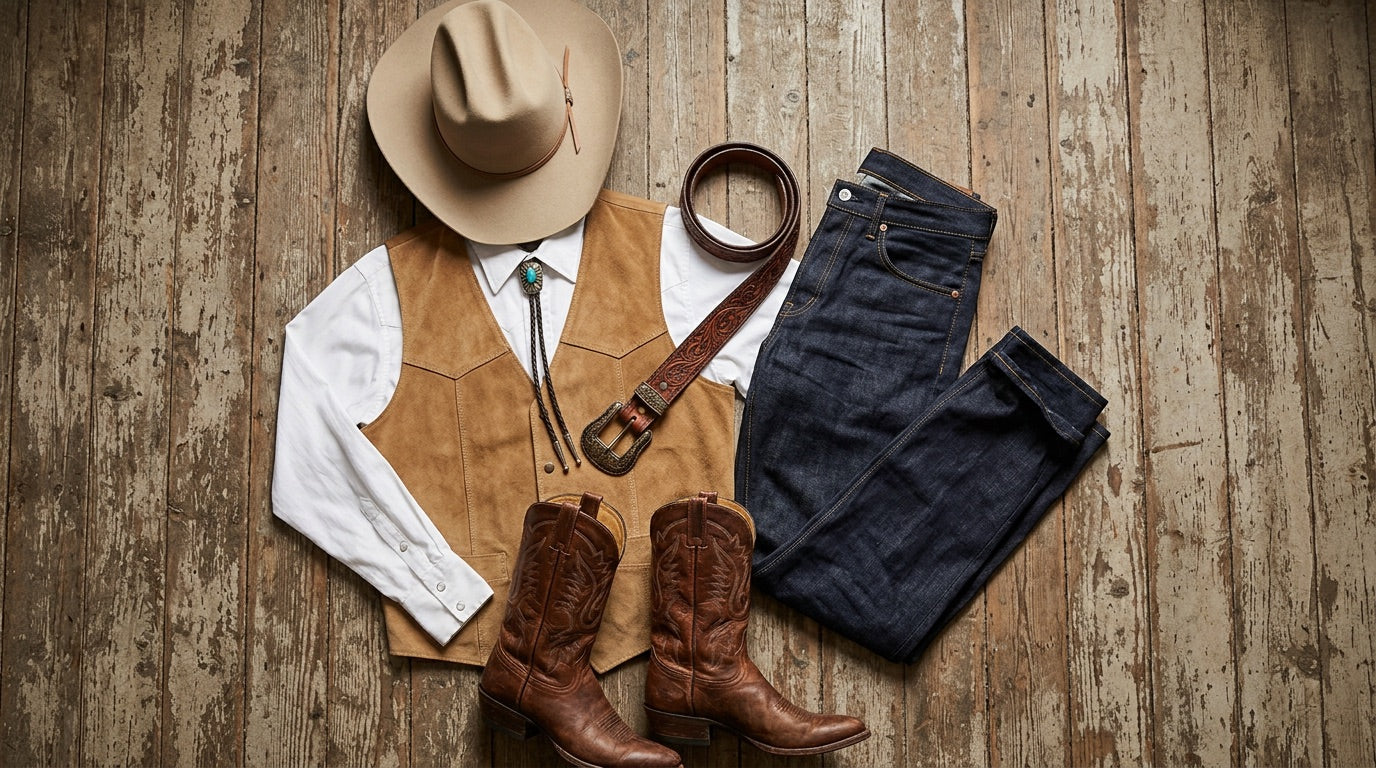
These films leave us with more than stories — they leave us with a silhouette. There’s no need to recreate a film costume: a few well-chosen pieces are enough to evoke John Wayne or Sam Elliott without looking like you’re dressed up. The trick is to wear two or three pieces at a time, never everything together.
The hat: the centrepiece
In Ford’s films and Leone’s, a hat tells you everything about a character: wide, battered brims for the drifter, neat felt for the sheriff. For your first one, a sand, brown or black felt cowboy hat works just as well with raw denim as it does with a wool jacket.
Cowboy boots and a belt
Angled heels and pointed toes are another hallmark of the genre. A pair of brown leather men’s cowboy boots, worn under straight-leg jeans, does the work of an entire costume. Add a crafted leather men’s Western belt, with a discreet buckle if you’re just starting out.
Vest, jacket and bolo tie
A sleeveless vest over a shirt is the poker player’s and sheriff’s outfit in half the films mentioned above. A suede or wool cowboy vest brings that look, while a canvas or leather cowboy jacket takes over when it gets cold. For a dressier touch, a bolo tie replaces a regular tie with a shirt buttoned right to the top.
For more tips on putting these pieces together day to day, read our men’s guide to Western style.
Explore our men’s cowboy hats →
Explore our men’s cowboy outfits →
Western actor FAQs
Who is the greatest Western actor?
John Wayne is the name that comes up most often: he worked with John Ford and Howard Hawks, and his Academy Award for True Grit (1969) cemented his career. Clint Eastwood is his only true rival, having made his mark on the genre as an actor for Leone and as a director with Unforgiven.
Which Western actor became President of the United States?
Ronald Reagan, president from 1981 to 1989. He made several Westerns in the 1940s and ’50s, including Santa Fe Trail (1940), then hosted the series Death Valley Days in the mid-1960s before becoming Governor of California.
Who were the spaghetti Western actors?
The best-known were Clint Eastwood, Lee Van Cleef, Eli Wallach and Charles Bronson, all American, alongside Italians such as Franco Nero, Giuliano Gemma, Terence Hill and Bud Spencer. Henry Fonda and Claudia Cardinale also starred in the genre’s masterpiece, Once Upon a Time in the West (1968).
Which Western actor had blue eyes?
Paul Newman, Henry Fonda and Terence Hill are the names most often mentioned. Sergio Leone, who cast Fonda as killer Frank, particularly liked the contrast between his reassuring blue eyes and the character’s cruelty.
Which Western actors are still alive?
According to public biographies checked in late October 2026, several figures from the genre are still alive, including Clint Eastwood (born 1930), Terence Hill (born 1939), Franco Nero (born 1941), Sam Elliott (born 1944) and Kevin Costner (born 1955). This information can change, so check the latest news before quoting it.
What’s the difference between a Western actor and a real cowboy?
A Western actor plays a role; a cowboy is someone who works on horseback looking after cattle, a real job that still exists on American ranches. Some historical figures such as Buffalo Bill and Wyatt Earp crossed over into show business: the former with his own troupe, the latter by visiting Hollywood film sets late in life.
Sources
- Wikipedia (EN), “John Wayne”: https://en.wikipedia.org/wiki/John_Wayne
- Wikipedia (EN), “Clint Eastwood”: https://en.wikipedia.org/wiki/Clint_Eastwood
- Wikipedia (EN), “Once Upon a Time in the West”: https://en.wikipedia.org/wiki/Once_Upon_a_Time_in_the_West
- Wikipedia (EN), “Death Valley Days”: https://en.wikipedia.org/wiki/Death_Valley_Days
- Wikipedia (EN), “Yellowstone (American TV series)”: https://en.wikipedia.org/wiki/Yellowstone_(American_TV_series)
- Wikipedia (EN), “Wyatt Earp”: https://en.wikipedia.org/wiki/Wyatt_Earp
- NPR, “Newman: A Fine Actor With Even Finer Eyes”: https://www.npr.org/2008/09/27/95135039/newman-a-fine-actor-with-even-finer-eyes
- Festival de Cannes, “Tommy Lee Jones”: https://www.festival-cannes.com/en/p/tommy-lee-jones/


